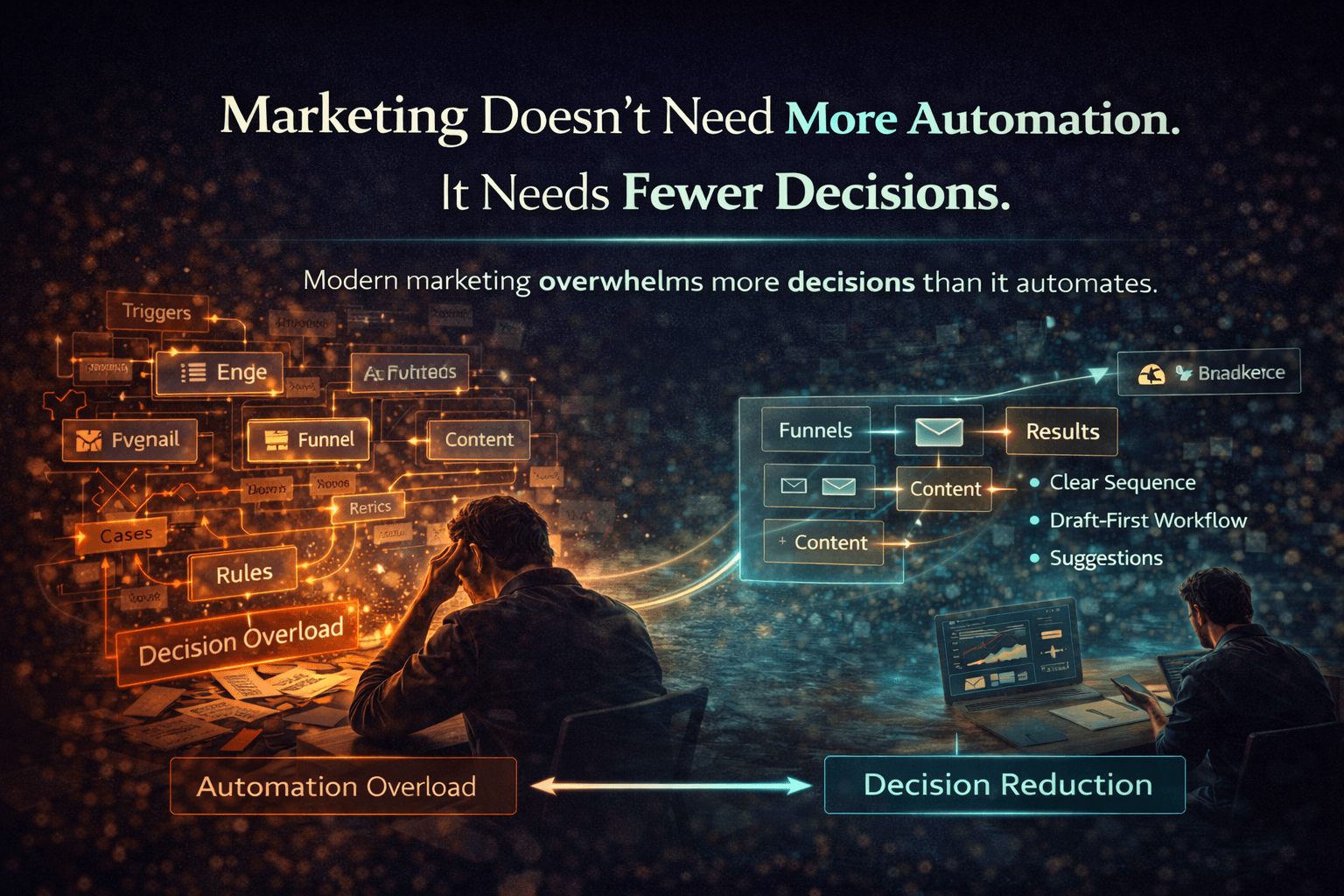
Marketing doesn’t need more automation.
It needs fewer decisions.
Founders aren’t short on tools.
They’re buried under them.
Workflows stack on top of workflows. Triggers multiply. Conditions branch. Rules get smarter—and heavier. Marketing becomes a machine that technically runs, yet still feels exhausting to manage.
That’s the uncomfortable truth most platforms avoid saying out loud:
Marketing doesn’t feel hard because it lacks automation.
It feels hard because it demands too many decisions.
This piece breaks down why decision overload is the real bottleneck, how automation often amplifies it, and what founders are doing differently in 2026.
Why Automation Became the Default Fix
When marketing slows down, the advice founders hear is predictable. Add automation. Build flows. Set up triggers. Let the system run.
On the surface, it sounds like relief.
In reality, automation usually front-loads the work. Before anything runs, founders must decide what connects to what, which path fires when, and how edge cases behave. Instead of removing effort, automation relocates it earlier—where it’s harder to see and easier to get wrong.
The promise is freedom.
The reality is configuration.
The Hidden Cost of Automation-First Marketing
Automation quietly assumes a lot is already figured out.
It assumes your strategy is clear.
It assumes your messaging is final.
It assumes you know the right sequence.
It assumes someone is watching the system closely.
Founders rarely have those conditions.
So they end up making decisions they shouldn’t have to make yet—decisions about triggers, branches, fallbacks, and fixes for problems they haven’t seen. The system becomes complex before it becomes useful.
Automation doesn’t remove decisions.
It multiplies them.
Automation vs Decision Reduction
| Automation-First Thinking | Decision-Reducing Thinking |
|---|---|
| Adds more rules | Removes unnecessary choices |
| Builds complex flows | Establishes clear sequences |
| Configures everything upfront | Decides only what matters now |
| Requires constant debugging | Needs occasional review |
| Feels powerful | Feels calm |
Founders don’t need more power.
They need less mental load.
Why Founders Burn Out on “Smart” Systems
Automation-heavy setups work—until reality changes.
Offers evolve. Messaging shifts. Context gets lost. Weeks later, a founder sees something fire and thinks, Why is this even happening?
That’s the moment the system stops serving the founder and starts demanding attention. Instead of asking what to do next, founders are forced to reverse-engineer their own logic.
That isn’t leverage.
That’s accumulated debt.
The Founder Trap: Automating Before Deciding
Most founders don’t automate too much.
They automate too early.
Emails get automated before the offer is clear. Funnels get wired up before messaging is validated. Follow-up runs before intent is understood.
Those assumptions get locked into code. And once they’re locked in, changing them feels risky and expensive.
The result is speed in the wrong direction.
What Actually Moves Marketing Forward
Marketing improves fastest when founders focus on decisions—not mechanics.
They decide what to ship.
They start from drafts instead of blank pages.
They publish intentionally.
They observe what happens.
They change one thing at a time.
This loop creates momentum with far fewer choices. Automation can support it—but only after the decisions are clear.
Decision Reduction Is the Real Leverage
High-performing founders don’t try to think faster.
They try to think less.
They reduce decisions by starting from defaults that make sense, keeping assets connected, reviewing instead of assembling, and letting systems remember context for them.
That’s how one founder produces consistent output without carrying everything mentally.
Where AI Actually Helps (And Where It Hurts)
AI hurts when it adds options, branches endlessly, or automates without context.
AI helps when it narrows the path.
Used correctly, AI holds brand memory, suggests the next best action, reduces choices to a small set of good ones, and preserves learning across launches. It supports judgment instead of replacing it.
AI should simplify the road—not turn it into a maze.
A Founder-First Example
OceanDrive wasn’t built to automate everything.
It was built to reduce decisions.
Instead of forcing founders to configure endlessly, OceanDrive generates connected launch kits—funnels, emails, and content plans—keeps brand context intact, tracks what shipped, and surfaces what to improve next.
Automation exists to support the workflow.
Judgment stays with the founder.
When Marketing Starts to Feel Calm Again
Founders notice the change quickly.
Launches feel lighter.
Fewer things break.
Decisions feel obvious.
Marketing stops draining energy.
That calm doesn’t come from more automation.
It comes from clarity.
What Founders Actually Need in 2026
Founders don’t need more triggers, branches, or rules.
They need fewer decisions, clear sequencing, draft-first workflows, and systems that remember what happened last time.
Automation should follow decisions—not replace them.
Final Takeaway
Marketing doesn’t fail because founders aren’t automated enough.
It fails because decisions pile up, automation locks in confusion, and no system exists to absorb the load.
Reduce decisions first.
Automate what remains.
That’s how marketing becomes sustainable.
Want Marketing With Fewer Decisions (Not More Rules)?
OceanDrive is opening early access in small batches.
It’s built for founders who want calm execution, clear next steps, minimal setup, and systems that improve over time.
👉 Join the early access waitlist
Early access waitlist
Get your AI launch kit first.
We’re opening OceanDrive in small batches to keep onboarding fast and support tight. Join the waitlist and we’ll invite you as soon as a spot opens.
- Funnel draft + email sequence + weekly content plan
- Built from your brand inputs
- You review, tweak, and publish — no black-box automation
Enter your email and we’ll notify you when your early access spot opens.