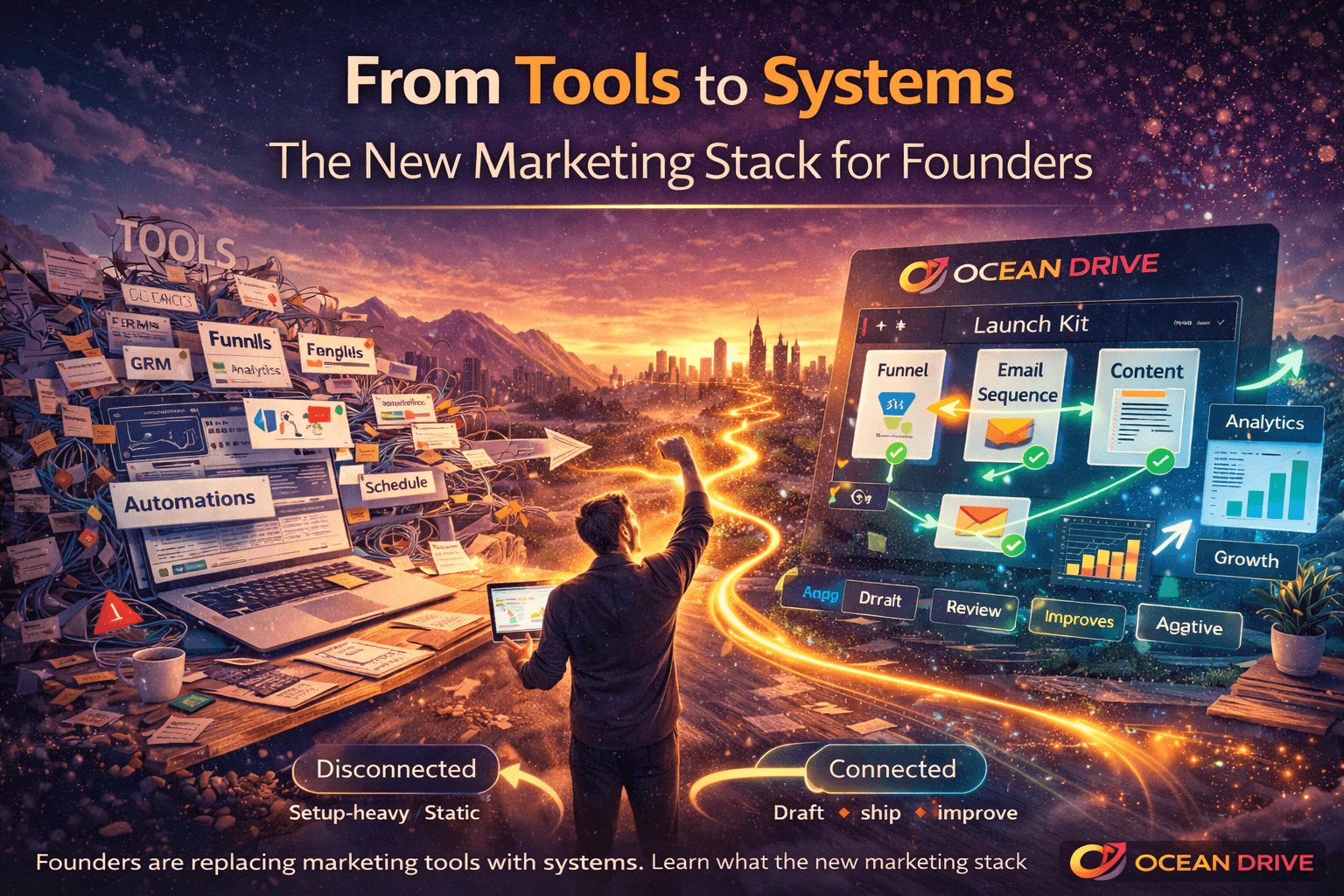
The marketing stack is changing.
Tools are giving way to systems.
In 2026, founders aren’t upgrading tools — they’re rebuilding how marketing runs.
The future marketing stack isn’t bigger.
It’s more coordinated.
For years, the “modern marketing stack” looked like a checklist.
Email tool.
Funnel builder.
CRM.
Scheduler.
Analytics.
If growth stalled, the fix was predictable:
“Add another tool.”
But founders in 2026 are doing something different.
They’re not upgrading tools.
They’re replacing stacks.
This article breaks down the shift from tools to systems, what the new marketing stack for founders looks like, and why this change is accelerating now.
The Old Marketing Stack Was Built for Tasks
Traditional marketing stacks were assembled around tasks.
Each tool answered a narrow question:
- How do I send emails?
- How do I build a page?
- How do I store leads?
- How do I track clicks?
Individually, the tools worked.
Collectively, they didn’t.
Because founders don’t experience marketing as tasks.
They experience it as a flow of decisions.
And tool stacks were never designed to manage decisions.
Why Tool Stacks Start to Crack
As stacks grow, friction grows with them.
Not because tools are bad — but because they’re disconnected.
Founders feel it as:
- Constant context switching
- Rebuilding campaigns from scratch
- Forgetting what shipped last cycle
- Manually syncing strategy across tools
- Spending more time setting up than launching
Nothing breaks.
But momentum slows.
That’s the moment founders stop questioning tools — and start questioning the stack itself.
Why This Shift Is Happening Now
This transition didn’t come out of nowhere.
Three forces pushed it forward.
1. Tool Saturation
Most marketing tools are already “feature complete.”
More features no longer mean more output.
2. Founder Time Compression
Founders don’t want optionality.
They want speed with clarity.
3. AI Reset Expectations
Once AI entered the workflow, founders asked:
“Why am I still coordinating everything manually?”
That question exposed the limits of tool-based stacks.
Old Stack vs New Stack
Here’s how the shift actually looks:
| Old Marketing Stack | New Marketing Stack |
|---|---|
| Tool-first | System-first |
| Channel-based | Outcome-based |
| Manual coordination | Connected workflow |
| Setup-heavy | Draft → ship → improve |
| Static | Learns over time |
Old stacks optimized execution.
New stacks optimize momentum.
What “Systems” Actually Mean in Marketing
A marketing system is not:
- A bigger all-in-one tool
- A dashboard with more tabs
- A smarter email platform
A system is a coordination layer.
- Connects strategy → assets → execution
- Holds brand voice, offers, and constraints
- Generates usable drafts
- Tracks what shipped
- Recommends what to improve next
Instead of asking:
“Which tool do I use?”
Founders ask:
“What’s the next thing to ship?”
How AI Changes the Stack (When Used Correctly)
AI doesn’t replace tools by working faster.
AI replaces tools by removing decisions.
Inside a system, AI can:
- Remember brand context
- Generate aligned funnels and emails
- Spot gaps across campaigns
- Suggest next-best actions
- Learn from approvals and outcomes
Used inside tools, AI is a feature.
Used inside systems, AI becomes infrastructure.
Why “All-in-One Tools” Aren’t the Answer
Many platforms claim to be all-in-one.
In practice, they’re often:
- Multiple tools bolted together
- Feature-dense but uncoordinated
- Flexible at the cost of clarity
A system isn’t about doing everything.
It’s about making the right things easier.
That distinction is why founders are moving on.
A Founder-First Example of the New Stack
For example, OceanDrive is designed around this system-first model.
Instead of asking founders to assemble:
- Funnel software
- Email software
- Planning tools
- Lightweight CRMs
OceanDrive provides:
- A connected launch kit (funnel + email + content plan)
- Draft → review → publish workflow
- Brand-aware guidance
- Performance snapshots
- Human approval by default
The system handles coordination.
Founders focus on decisions.
What Founders Are Really Replacing
Founders aren’t replacing:
- Email tools with other email tools
- Funnel builders with better builders
They’re replacing:
- Tool chaos → execution flow
- Decision overload → clarity
- Setup cycles → iteration
That’s why this shift sticks.
When Tools Still Make Sense
Tools still make sense if:
- Marketing isn’t a core growth lever yet
- You enjoy stitching systems together
- You need extreme customization
- You’re in early validation mode
Tools aren’t obsolete.
They’re just no longer the default stack.
When Founders Know It’s Time for a System
Founders usually feel it when:
- Marketing feels heavier every quarter
- Adding tools doesn’t increase output
- Launches stall after setup
- They want fewer decisions, not more options
That’s when the system model clicks.
Final Takeaway
The future marketing stack isn’t:
- Bigger
- More complex
- More automated
It’s more coordinated.
Founders in 2026 are moving from:
- Tools → systems
- Execution → orchestration
- Setup → momentum
That’s the new marketing stack — and it’s already replacing the old one.
Want to See the New Stack in Action?
OceanDrive is opening early access in small batches.
It’s built for founders who want:
- Fewer tools
- Faster launches
- Clear next steps
- Marketing that improves every cycle
All from one focused system.
👉 Join the early access waitlist
Early access waitlist
Get your AI launch kit first.
We’re opening OceanDrive in small batches to keep onboarding fast and support tight. Join the waitlist and we’ll invite you as soon as a spot opens.
- Funnel draft + email sequence + weekly content plan
- Built from your brand inputs
- You review, tweak, and publish — no black-box automation
Enter your email and we’ll notify you when your early access spot opens.